Initially created by a PCV serving in Mongolia, the Peace Corps Challenge challenges one to live as a Peace Corps volunteer would. The purpose of the project is to give those living stateside/in the western world a taste of what life is like in the Peace Corps in developing countries. In no way is it indicative of any one PCV's experience; the project merely challenges the participant to experience a different way of living for a week, and to live outside of one's comfort zone. I've included the rules for the Challenge adapted by PCV's in Kenya below, as it most logically mirrors the realities of living in Uganda. I encourage you to take on the Challenge, and report back to me your thoughts. Enjoy!
The Challenge: Kenyan Rules
For one week, you are asked to give up some of the everyday conveniences that we PCV's and our communities do without. The levels are arranged from more common to less common living conditions of PCV's in Kenya while also taking into account the difficulty of completing the challenge in the U.S. So while none of us here have a car, it ranks quite high in the challenge as it is much more difficult to do without one in the States. Kenya is known for its beautiful safaris in which you can spot the “The Big Five” animals, for which we’ve named our levels (they are in order of rareness in the Masai Mara).
First, decide which month you want to participate. The first week of the month you choose (the 1st-7th) will be when you need to forgo certain items.
Next, look through the list below and decide which one of the five levels of difficulty you want to take on, and which items you will abstain from (although your items may come from multiple difficulty levels, you are only trying to complete one level...the most difficult you think you can manage).
Finally, let us know that you’ve taken up the challenge by completing the Accept the Challenge section of the general “Live Like a PCV” at Live Like A PCV.
Lion: Difficulty Level I
(choose two)
- Forgo the use of the microwave.
- No checks, no debit cards, or no credit cards all week. Cash only.
- No washing machine or dish washers - plus you must attempt laundry by hand once.
- Cook dinner by candlelight.
- Keep a journal or write a handwritten letter to a friend about your experiences this week.
Buffalo: Difficulty Level II
(choose two, plus one item from Level I)
- No television - you can, however, listen to the radio and read local newspapers.
- Baths or showers are allowed only every other day - you can wash yourself at the sink with a cloth as much as you want.
- No fast food- or restaurant-eating - this includes no coffee joints, bars, and delivery services.
- Internet use only every other day - you can use the internet for your job, but you're on the honor system here.
- Start and finish a book this week.
- Buy your fruits and vegetables for the week locally.
- Wild Animals! You can't leave your yard between 7:30 PM and 6:30 AM unless you're accompanied by 3 or more people.
Elephant: Difficulty Level III
(choose two, plus one item from Level II or two items from Level I)
- You can use your toilet but you must manually fill the tank or do a bucket flush (turn off the water to the toilet.)
- Lack of temperature control - no heater or air conditioner in your house/car.
- Greet everyone you know with a handshake and genuine questions about their family, home, and health.
- You can only use one burner on your stove (no oven).
- Ration your water to only 10 gallons a day for cooking, drinking, bathing, and washing clothes.
- Teach someone the 4 ways that HIV is transmitted.
Leopard: Difficulty Level IV
(choose two, plus one item from Level III, or two items from Level II, or three items from Level I)
- Reduced living space - you may only use your living room, bathroom, and kitchen.
- Bathe only once this week - you may wash yourself with a cloth at the sink everyday.
- No driving - you can use public transport, a bicycle, or simply walk.
- Internet only once this week - again, you can use it for your work only.
- Power outage - throw a 6-sided dice everyday to determine how many hours you will be without power between the hours of 5:00pm -11:00pm (turn off your power breakers).
Rhino: Difficulty Level V
(choose one item from each Level)
- No running water in your house - you must fetch it from somewhere else (e.g. a neighbor’s house).
- No English for the entire week - you can speak English only at work.
- No toilet use in your house - you must go somewhere else or improvise.
- No refrigerator use.
- Spend the whole weekend in one room of your house - using no electricity, you are allowed 3 books and 1 full battery life of your computer (no recharging).
Questions for Reflection:
* How did you find the Challenge? Difficult or easier than you anticipated?
* What surprised you about most about participating in the Challenge?
* What did the Challenge teach you about how people in developing countries live?
Serving as a Peace Corps Community Health volunteer in Uganda.
Friday, April 8, 2011

Thursday, April 7, 2011
A Quote for Thought
Quoted from a volunteer's account of her Peace Corps experience in Ecuador, as well as her experience living in northern (Arua) Uganda for 3 years:
"How different it all was from the life of push-button ease and an antiseptic technology that I had left behind. It struck me then, for the first time, that life in America was the aberration. The life that played out below me - barefoot and soily, among animals, in a forced intimacy with the earth - this was how most of the people on this planet lived. With its stark existence and uncomfortable realities, this was the world that I was going to have to learn to be at home in if I wanted to survive the Peace Corps."
"How different it all was from the life of push-button ease and an antiseptic technology that I had left behind. It struck me then, for the first time, that life in America was the aberration. The life that played out below me - barefoot and soily, among animals, in a forced intimacy with the earth - this was how most of the people on this planet lived. With its stark existence and uncomfortable realities, this was the world that I was going to have to learn to be at home in if I wanted to survive the Peace Corps."
Tuesday, March 29, 2011
Work Updates
"A Finalized Budget"
Mentioned in previous posts, my primary project is to help fundraise for the construction of a maternity and child's ward adjecent to the dispensary. Over the past couple of days, the projected budget for the project was finalized, factoring in the expenses for the required materials for site clearence/excavation; the construction of the building's ceilings, walls, windows, doors, and internal/external finishings; and for labor and the transport of materials, supplies, and equipment to the work site (a majority of which has to be purchased in Mbale 20 minutes away). As it stands now, the projected cost of the building estimates at 96 million Ugandan schillings, or roughly $40,000. If you'd like me to forward you the excel spreadsheet of the projected budget, please let me know.
Our next step is to begin sensitizing the community through public outreaches and meetings with community/religious leaders, as well as reaching out to potential donors in the area. In the next couple of months, I also hope to train community members in proposal/grant writing. While I'm cautiously optimistic that we'll be able to fundraise the projected amount in the next 1 1/2 years, I hope to inspire people to take ownership in the project themselves, for instance developing their own strategies for reaching the target sum.
"The Benefits of Worksheets"
Although I've been co-teaching S3 English 3 days a week and S3 Geography 1 day a week, I view my role is more as a teacher's aide/mentor. In particular, I'm trying not to overstep my boundaries and be the "primary teacher." As soon as the lesson ends for the day, for instance, teachers tend to abruptly leave their class and head back to the teacher's quarters. I stay behind to help the students with their work or to answer any questions. I consider myself to be more useful this way than by introducing new material.
One of the main problems with the Ugandan schooling system is that students are generally not encouraged nor challenged to think critically, asking why something is the way it is. For the first few weeks, I merely observed students copying the material off the board, not necessarily understanding what was being taught or asking questions. To counter this problem, I've decided to write weekly worksheets/practice exercises that not only check for comprehension, but also provoke critical thinking and creativity. Last week, I put the notion of worksheets to the test, and it worked wonders. It was like night and day. A good majority of the class participated in the exercises; students seemed to be more actively engaged in the material and enthused for learning. Its success was confirmed when my co-teacher asked me after the lesson if I could produce more worksheets the following week. I gladly accepted.
I was also excited last Friday when a couple of students asked me if they could have "pen-pals" from the United States. I'm not sure about the feasibiity of "pen-pals" due to the poor mailing system in-country, but I'm still trying to organize some form of letter/postcard exchange with a middle school or high school class back home. The benefits of cross-cultural learning is tremendous, and certainly aligns with two of Peace Corps' core goals.
"Libraries for Life"
Described in an earlier blog post, my "Libraries for Life" secondary project is now in full swing. Partnering with Books for Africa (BfA) and working with fellow PCV Linda Baum, the project aims to instill an educational yet fun culture of reading by building libraries constituting 22,000 donated books (provided by BfA) in two preidentified schools.
In preparation for the arrival of the 22,000 books in-country later this year, I'm trying to ready the classroom-turned-in-library by getting workers to paint the room's walls; install iron bar windows; and secure tables, bookshelves, and chairs, hopefully of which will be donated by a carpenter in town.
All that stands between the books' arrival into port (Kampala) and delivering the books to the schools is $15,000 ($12,700 shipping charges, $2,000 port/clearence charges) that needs to be fundraised. If you are interested in donating to the cause, please be on the lookout for the "Libraries for Life - Peace Corps Uganda 2011" project group page on facebook (I will create this soon), as well as the donation page linked from the Books for Africa website (I will send this out soon).
Here is more detailed information about our project:
Project Title: Libraries for Life - Peace Corps Uganda 2011
Project Objectives:
(1) To fight poverty through reading
(2) To enhance the quality of teaching of the teachers and the quality of learning of the students by providing them with textbooks, reading materials, novels, and other resources
(3) To train preidentified teachers in library management so that the libaries can be sustainable, long-term, and achieve their intended purposes
Who Will Benefit: The students and teachers at Kogunga High Secondary School in Kachumbala, as well as at another primary or secondary school in Soroti.
Where Donations Will Go: All donations will go to clearing and paying for the shipping/port charges upon the books' arrival in-country.
Contact Information: bkobick@gmail.com, lindabaum@msn.com
Thank you in advance for any sum of money you are able to donate!
"Also..."
I am interested in setting up either a weekly youth group that promotes integrity, teamwork, and companionship through sports, games, and other recreational activities, or a girls empowerment group that allows them to openly discuss issues, challenges, or problems they are currently facing in their lives (I would co-lead this group with my supervisor for the presence of a female figure). Hopefully, I am able to start one of these groups soon.
"Events on the Horizon"
UPCOMING EVENTS
April 1st - Peace Corps' 50th Anniversary Celebration
April 19th - Celebrating Passover in Mbale, as well as my mother's birthday in spirit!
April 24th - Celebrating Easter at a fellow PCV's site
April 26th - Promoting World Malaria Day at a fellow PCV's site with guest speakers, educational activities, games/contests, a dance party, and a mosquito net distribution.
Top '#' Lists
To acknowledge and reflect upon my first 6 months at site and 8 months in-country, I've decided to create "top lists" of everything: my experiences, my longings and desires, my "only in Uganda" moments, among other things. These lists are not ranked in any particular order, but just what first popped into my head. Hope you enjoy.
TOP 7 THINGS I WISH I PACKED
(1) Kindle - A great, mobile alternative to paperbacks.
(2) External harddrive - I regret my decision to not bring this.
(3) Netbook - If I had known my ex-computer was going to get stolen, I would have left the Mac at home in place of a Netbook.
(4) Athletic pants - See my post about Ugandan children staring and requesting that I give them my leg hair on the football field.
(5) Batteries - I thought that I brought enough AA's, AAA's, and D's to last a year. I ran out within 2 months. You can never have enough batteries in Uganda.
(6) Soccer cleats - Self-explanatory.
(7) Camping pack - Mobile and easy-to-carry; great for weekend trips.
TOP 5 THINGS I WISH I LEFT HOME
(1) Travel-size mattress pad - It's been used once in-country, took up a lot of space, and could have been replaced with more useful things.
(2) The Peace Corps invitation packet - It hasn't been used once since I left the States.
(3) My ex-Mac computer - See #3 from the list above.
(4) 1 duffel bag - Painstakingly difficult to transport, even with rolling wheels. I insisted on taking 2 duffels; my parents thought otherwise. I was clearly wrong.
(5) Solar shower - I haven't used it once. Bucket baths are simpler and more time-efficient.
TOP 5 THINGS I USE MOST FREQUENTLY
(1) Headlight - Essential!
(2) Travel-size clock/alarm clock - I use it every morning to wake up. Plus, it still works fine despite dropping it on the ground repeatedly. Thanks Brookstone.
(3) Belts - Belts are a "daily must" if I'm to keep my now-oversized pants on my waist.
(4) Travel-size pillow - The pillow that Peace Corps gave us was flat and unsleepable. My small, travel-size pillow is far superior.
(5) Doom spray - Effectively controls the cockroaches, ants, and other critters that like to run rampant and sneak under my door and into my room. It's a good thing you can buy this stuff in-country.
TOP 6 THINGS I MISS FROM HOME
(1) Friends and family - Their love, support, and companionship.
(2) Home-cooked meals - The pungent smells of tacos, potato pancakes, and hens permeating my nostrils.
(3) My car - The smooth easy driving of my Scion XB. Just ask my mother.
(4) Snow - Snow or weather below 40 degrees.
(5) Reliable power and running water - Not essential, but it would be nice to have.
(6) Boston sports - Predictable response, eh?
TOP 10 FEATURES OF AMERICAN CULTURE/SOCIETY THAT NOW SEEM FOREIGN TO ME
(1) Fast-food restaurants
(2) Movie theaters
(3) Paved, dirtless roads without potholes
(4) Flushing toilets
(5) Highways/roads in which drivers adhere to the speed limit and drive inside their lane
(6) Air conditioning
(7) Hot and cold seasons
(8) Democratic elections rid of vote rigging
(9) High-speed internet
(10) Jewish temples
TOP 4 STEREOTYPES/CULTURAL ASSUMPTIONS I'VE RECEIVED AS A MZUNGU (VERBATIM)
(1) "You are rich, and have money."
(2) "You can't play football."
(3) "You must be from Norway because you are tall, have white skin, and wear warm clothes."
(4) "Didn't you bring mzungu women for us to marry?"
TOP 5 UGANDAN FOODS
(1) Chapatti - Flat, pancake-like bread made of flour and water.
(2) Groundnuts - Uganda's version of peanuts
(3) Atap - Millet bread eaten in the eastern region of Uganda
(4) Jackfruit - Best fruit in Uganda
(5) Passion fruit juice - Tastes similar to orange juice
TOP 5 UGANDAN WORDS
(1) Epikipik (eh-pic-ee-pic) - "Boda boda" in Ateso
(2) Asepulia (ah-seh-poo-lee-ah) - "Sauce pan" in Ateso
(3) Mpola mpola (ehm-poh-la-poh-la) - "Slow, slow" in Luganda
(4) Toto (toh-toh) - "Mother" in Ateso
(5) Yoga (Yo-gah) - "Hello" in Ateso
TOP 4 DESIRED PLACES OF TRAVEL IN UGANDA
(1) Bwindi Impenetrable National Park to see the mountain gorillas.
(2) Queen Elizabeth National Park to see the elephants, hippos, buffaloes, waterbucks, crocodiles, and abundance of other animals.
(3) Murchison Falls to see, well, the Falls.
(4) Mt. Elgon National Park to climb Mt. Elgon and look out at the views of Kenya in the distance.
TOP 6 DESIRED PLACES OF TRAVEL OUTSIDE UGANDA
(1) Egypt, despite recent political events, to see the Great Pyramids, the Sphynx, and the Nile River.
(2) India to see the Taj Mahal and where Bollywood originated.
(3) South Africa to see one of Africa's most prosperous countries.
(4) Turkey to see the Hagia Sophia, the Grand Bazaar, and Asia/Europe simultaneously.
(5) New Zealand to see where Lord of the Rings was filmed.
(6) Fiji to experience paradise.
TOP 8 NEW EXPERIENCES
(1) Sleeping under a mosquito net every night.
(2) Rafting the Nile River and flipping over twice from Class II and Class III rapids.
(3) Living with no power or running water for 1 1/2 weeks (and counting).
(4) Being welcomed by children at an orphanage home with a remarkable dance and instrumental performance.
(5) Co-teaching English to 80+ secondary school students.
(6) Experiencing my first Ugandan wedding and baptism.
(7) Speaking 2 minutes of Ateso to a Catholic Church congregation of over 600 people. Eruptions of laughter and applause ensued.
(8) Slowly but surely becoming fluent in a Ugandan language.
TOP 5 "ONLY IN UGANDA" MOMENTS
(1) Crowding 20 people in a matatu meant to seat 15 people.
(2) Inadvertantly causing babies to cry because of my terrifying physical appearence.
(3) Jokingly asking the Ugandan driver of a matatu, who was wearing a 2007 Red Sox championship t-shirt, if he pawked the cah in Hawvid Yawd. His reply? "Only in Boston, sir."
(4) Being asked by a Ugandan man if I would take his 2 wives to America in exchange for 5 cows or 10 goats.
(5) Torrential rain pouring 1 minute, the sun revealing itself the next, only for it to start pouring again 2 minutes later.
TOP 4 THINGS I'VE LEARNED FIRSTHAND
(1) Don't sweat the small stuff.
(2) The true value of water.
(3) I have the ability to make a much more positive impact in other people's lives than I previously thought.
(4) I want a career/job that requires international travel, or that will enable me to live abroad.
TOP 2 POST-PEACE CORPS UGANDA OPTIONS
(1) Peace Corps Response - Working in another developing country for 6-12 months with a more specific job description and defined role.
(2) Making the inevitable decision of what I want to do with my life by either heading back to graduate school and pursuing a more career-tailored degree, or testing my luck in the job market and beginning to apply for jobs.
I look forward to what the next 1 1/2 years have in store. As always, thanks for reading!
Sunday, March 20, 2011
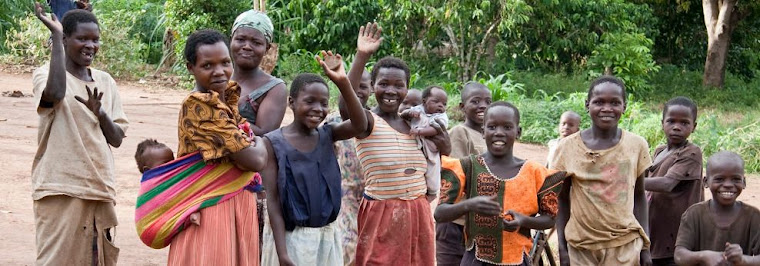
The Faces of Kachumbala

Betty posing for the camera.

My neighbor. I often play soccer with him when he comes home from school.

My counterpart, Fr. Okurut, after Sunday mass.

My favorite shopowner, Cyrus, with his son. His shop is where I buy my bread, beans, rice, and drinks.

Fr. Paul, Fr. Okurut, and Silver drinking their nightly ajon. Personally, I prefer beer.

Flo cooking up something tasty.

S3's (equivalent of 10th/11th grade) Emma and Julius. I teach these guys English and Geography.

My supervisor, Rose, with Zefara, a nurse at the dispensary.

Silver. Hands down the best chef in Kachumbala.

When I was walking back from the market, I ran into these guys. Once they saw my camera, they insisted that I take a picture of them until I got it right. This was the 3rd attempt.

My self-proclaimed, Ugandan "toto"/mother (in the middle) in Kachumbala.

Ugandan children hanging out by the borehole, which hasn't been working for several months.

Ugandan children riding a bike. Especially in the villages, bikes are a common mode of transportation.

A Ugandan child playing after Sunday mass.
Friday, March 11, 2011
The Challenges of Development Work in Uganda
Listed below are challenges I have encountered and observed as a development worker in Uganda. I cannot claim if these challenges are indicative of all development workers'/PCV's experiences in Uganda or throughout Africa. Rather, they are just what I have experienced firsthand 5-months in at site. Note how the challenges are all interrelated.
The Issue of Motivation: Cultural differences! One significant difference between American and Ugandan culture that I've observed lies in the area of motivation. Most of the people I have met are well aware of the challenges that afflict their livelihoods, but they do not always employ positive changes/solutions to overcome such challenges. In my experiences thus far, for example, it is more the norm for people to show up to meetings, trainings, demonstrations, or public outreaches late or even not at all. There needs to be motivation if effective development work is to take place.
The Issue of Community Mobilization/Ownership: Mobilizing community members to act on their own behalf has been my greatest challenge as a development worker. My supervisor recently told me that there needs to be an attitude shift from "What you can give me" to "What I can do for myself," whereby people take ownership of their problems/potential solutions if they are to improve their livelihoods. My role as a Peace Corps volunteer is not to provide, but to facilitate the development of this ownership. Now, when I hear, "Mzungu, give me money," I simply ask, "What can you give yourself, first?"
The Issue of Sustainability: Peace Corps' approach of sustainability may not seem viable in a country where 35% of the population live below the poverty line. Long-term, development work can be particularly challenging with the short-term orientations of many Ugandans. Long-term saving/family planning for a child's university tuition 10 years down the road, for instance, is understandably not a well-practiced concept in Uganda.
The Issue of Urgency: Coming to Africa, I knew that development work took a lot longer in Uganda than it did in the States, but I was admittedly ill-prepared for just how long. For my primary project, for instance, I am training the staff in my organization to fundraise for the construction of a maternity and child wing adjacent to the clinic. I asked the builder to make a projected budget for the building so that we can set a target goal for our fundraising efforts. It's been three weeks now, and the projected budget is still a work in progress. I fully understand that one cannot compare the rate at which things get accomplished in Uganda to that in the States, but development work lags behind in-country as a result.
The Issue of Resources: Shortages of resources (financial, educational, medical, etc) greatly challenge development work in Uganda. How can children effectively learn/teachers effectively teach if there are no textbooks or workbooks in the classroom? How can people be tested for malaria if there is not sufficient medical equipment in the health clinic?
These are some of the challenges that I've faced as a Peace Corps volunteer in Uganda.
The Madness of March
Those who know me best know that my favorite time of year is in early spring. "Why?"
The changing of the seasons from winter to spring?
Daylight savings (setting clocks forward - gets darker later)?
St. Patrick's Day?
Spring training and the anticipation of the upcoming baseball season?
No. Early spring is my favorite time of year because of a collegiate, nation-wide sporting competition that puts 'bracketology' at the forefront of every likeminded fan's mind.
Who will be the first #1 seed to go down? Which 'sleeper team' will make the Final Four? Who will win the national championship? What will be the "perfect bracket"?
These are all questions I tackle as I listen to ESPN college basketball analysts make their predictions, do my online research, and fill, refill, double-refill, and triple-refill my backet until I am satisfied. On average, I probably go through 5-6 backets every year re-perfecting my bracket. In actuality, I just shoot myself in the foot. Do I ever trust my first instincts? Never. I always question why I have Kentucky beating Duke or Purdue beating Florida. It is an obsession for me. But this second-guessing is also why I love March Madness so much. I love the unpredictability, the parity, and the suspense of the tournament, when any team can make a magical, Final Four run like George Mason did in 2006. Do I drive myself crazy with my second-guessing? Absolutely. Will I continue to do so, year in and year out? You betcha.

Subscribe to:
Posts (Atom)